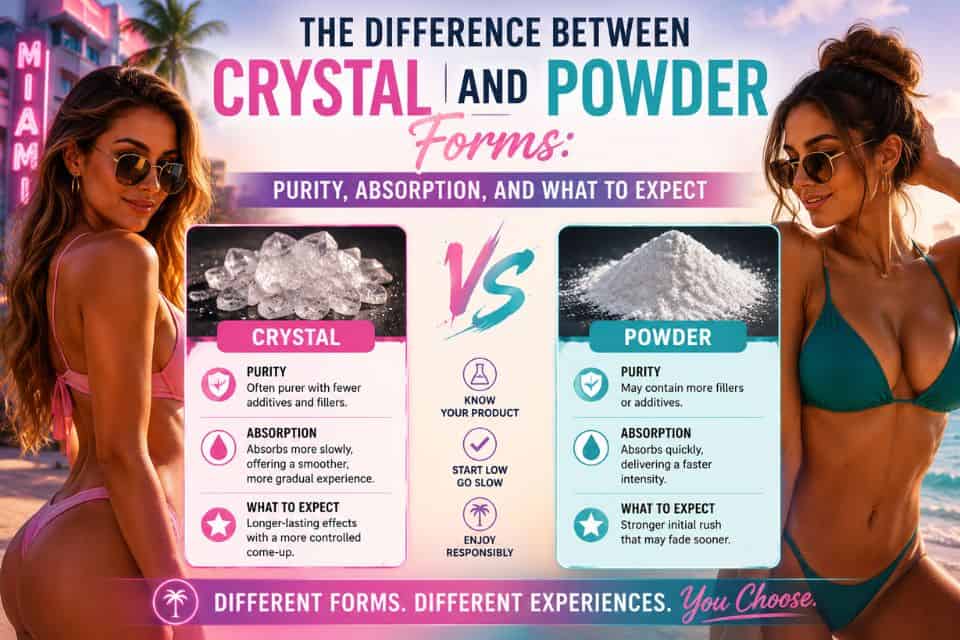
The Difference Between Crystal and Powder Forms: Purity, Absorption, and What to Expect
It’s a familiar scene for many: you’re at a party, a festival, or a friend’s place, and someone offers you something. Maybe it’s a small baggie of glistening crystals, or perhaps a folded piece of paper containing a fine powder. You might have wondered, “What’s the difference, really?” It turns out, the physical form of a substance—crystal or powder—can tell you a surprising amount about its potential purity, how it will be absorbed by your body, and ultimately, what kind of experience you can expect. This isn’t about judging one form as “better” than the other, but about understanding the science so you can make more informed decisions. As your trusted, chemistry-savvy friend, I’m here to break it all down for you.
The Chemistry of Crystals vs. Powders: A Look Inside
At a microscopic level, the difference between a crystal and a powder is all about organization. Think of it like the difference between a well-built brick wall and a pile of sand. Both are made of the same basic material, but their structure is completely different.
What is a Crystal?
A crystal is a solid material whose constituent atoms, molecules, or ions are arranged in a highly ordered, repeating pattern extending in all three spatial dimensions. This internal structure, known as a crystal lattice, is what gives crystals their characteristic flat faces and sharp angles. In the world of recreational substances, the formation of large, well-defined crystals is often a good indicator of purity. Why? Because for a crystal to grow, the molecules need to be of the same type to fit neatly into the lattice. Impurities disrupt this process, resulting in smaller, less defined crystals, or preventing crystallization altogether.
What is a Powder?
A powder, on the other hand, is a dry, bulk solid composed of a large number of very fine particles. These particles can be tiny, crushed crystals, or they can be amorphous, meaning they lack the ordered internal structure of a crystal. From a practical standpoint, the most important thing to understand about powders is that their large surface area and loose composition make them incredibly easy to mix with other substances. This is where adulterants, or “cuts,” often come into play. It’s far easier to mix a cutting agent like baking soda, talc, or even another, cheaper drug into a powder than it is to incorporate it into a solid crystal.
A Practical Comparison: What to Expect
When you’re looking at a substance, its form can give you some initial clues about what you’re dealing with. But it’s not just about looks; the physical form has a direct impact on how the substance interacts with your body. Let’s dig a bit deeper into what this means for some of the products you might encounter.
Let’s take a look at some common substances and how their form can impact your experience.
MDMA
- Crystal “Molly”: Often appearing as clear or brownish crystals, this form of MDMA is generally perceived to be purer. Because the crystals need to dissolve before they can be absorbed, the onset of effects might be slower and more gradual, leading to a smoother, longer-lasting experience. This can be a more manageable and less overwhelming way to experience the effects of MDMA. The experience is often described as a gentle wave of euphoria and empathy that builds over time, rather than a sudden, jarring rush. This can be particularly beneficial for those who are new to MDMA or who are sensitive to its effects. It allows for a more introspective and emotionally connected experience, which is often what people are seeking from this substance.
- Powdered MDMA: While it can simply be crushed crystals, powdered MDMA is also more likely to be cut with other substances. The increased surface area of a powder means it will be absorbed more quickly, potentially leading to a faster and more intense come-up. This can be desirable for some, but it can also be more jarring and harder to manage, especially if the powder contains unexpected adulterants. The rapid onset can sometimes lead to anxiety or a feeling of being overwhelmed, particularly if the dose is higher than anticipated. Furthermore, the presence of cutting agents can muddy the experience, introducing unwanted side effects like jitteriness, nausea, or even dangerous cardiovascular effects. This is why testing is so crucial, especially with powdered substances.
- Internal Link: For more information on MDMA, check out our MDMA product category.
Cocaine
- “Fish Scale” (Flakes/Crystals): This form of cocaine gets its name from its shimmery, pearlescent appearance, which is a result of its crystalline structure. It’s generally considered to be of high purity. The effects are often described as cleaner and more euphoric than those of powdered cocaine. Users often report a more focused and clear-headed high, with less of the anxiety and paranoia that can sometimes accompany cocaine use. The crystalline structure is a testament to its purity, meaning you’re getting more of the desired compound and less of the unwanted and potentially harmful filler.
- Powdered Cocaine: This is the most common form of cocaine, but it’s also the most likely to be adulterated. Cutting agents can range from relatively harmless substances like baking soda or cornstarch to more dangerous drugs like fentanyl or research chemicals. The presence of these adulterants can not only diminish the desired effects of the cocaine but also introduce a host of new and potentially dangerous risks. Common cuts like benzocaine or lidocaine can numb the gums, mimicking the effect of real cocaine, but they don’t produce the same psychoactive effects. More dangerous adulterants like levamisole, a deworming agent for cattle, have been linked to severe immune system problems. And, of course, the ever-present threat of fentanyl contamination is a life-threatening concern.
- Internal Link: To learn more about cocaine, visit our Cocaine product category.
Ketamine
- “Shards” (Crystals): Ketamine crystals, often referred to as “shards,” are generally considered to be the purest form of the drug. The experience is often described as being cleaner and more predictable than with powdered ketamine. The ‘k-hole,’ a state of profound dissociation, can be a more navigable and less chaotic experience when the substance is pure. The journey into and out of this state is often smoother, with a clearer sense of the psychedelic landscape.
- Powdered Ketamine: As with other substances, powdered ketamine is more susceptible to being cut with other drugs. This can lead to an unpredictable and potentially dangerous experience, as you may not know what you’re actually taking. Adulterants can not only alter the psychoactive effects but can also have their own set of risks. For example, the presence of other dissociatives with different potencies or durations can lead to a much longer and more intense experience than anticipated.
- Internal Link: For more on ketamine, see our Ketamine product category.
4-MMC (Mephedrone)
- Crystals: Mephedrone is often sold as small, clear or yellowish crystals. This form is generally preferred by users due to its perceived purity. The effects are often described as being more euphoric and less ‘edgy’ than with powdered mephedrone. The clean, crystalline structure is a good indication that you’re getting what you paid for.
- Powder: Powdered mephedrone is also common, but As with other powders, it carries a higher risk of adulteration. This can lead to a less desirable experience, with more side effects like anxiety, paranoia, and a harsh comedown. Given the already stimulating nature of mephedrone, the addition of other stimulants as cutting agents can be particularly risky for cardiovascular health.
- Internal Link: Explore our 4-MMC product category for more details.
Bioavailability and Onset Times: The Science of Absorption
Now, let’s get into the nitty-gritty of how your body processes these different forms. The concepts of bioavailability and onset time are crucial for understanding why a crystal and a powder of the same substance can produce such different experiences.
Bioavailability is a term used in pharmacology that refers to the proportion of a drug that enters the circulation when introduced into the body and is therefore able to have an active effect. The form of a substance plays a significant role in its bioavailability and, consequently, its onset time.
As we’ve touched on, crystalline forms generally have a smaller surface area than powders. This means they dissolve more slowly in the stomach and are absorbed into the bloodstream more gradually. The result is a slower onset of effects, which can be a good thing if you’re looking for a more manageable and less overwhelming experience. Powders, with their much larger surface area, dissolve and are absorbed much more quickly, leading to a faster and more intense onset. Think of it like dissolving sugar in water. A sugar cube will dissolve much more slowly than an equal amount of granulated sugar. The same principle applies here. The faster absorption of powders can be a double-edged sword. While it can lead to a quicker and more intense experience, it also increases the risk of being overwhelmed, especially if the dose is misjudged. It also means the effects may not last as long, potentially leading to more frequent redosing.
Ultimately, the choice between a slower, more gradual experience and a faster, more intense one is a matter of personal preference. However, it’s important to be aware of how the form of a substance can influence its effects so you can make an informed decision.
Harm Reduction Tips
Regardless of whether you’re dealing with a crystal or a powder, harm reduction should always be a top priority. Here are a few tips to keep in mind:
- Test your substances: This is the single most important thing you can do to protect yourself. Reagent test kits can help you identify the primary substance in your sample and rule out the presence of dangerous adulterants. You can find a variety of drug testing kits from organizations like DanceSafe. For a comprehensive overview of our offerings, you can also browse our full range of lab-tested products.
- Start with a small dose: This is especially important when you’re trying a new batch of a substance, regardless of its form. You can always take more, but you can’t take less.
- Be aware of the risks: Powders are more likely to be adulterated, but that doesn’t mean that crystals are always pure. Always be mindful of the potential for unexpected effects and have a plan in place in case something goes wrong.
- Know your sources: Whenever possible, try to get your substances from a trusted source. While this isn’t a guarantee of purity, it can help to reduce the risk of adulteration.
External Citations
For those who want to dive deeper into the science, here are a couple of authoritative sources:
- BCCSU – Guidelines for Identifying Colours and Textures: This guide from the British Columbia Centre on Substance Use provides a detailed overview of the different forms of various substances. Read the guide
- Erowid: This is an excellent resource for information on all things related to psychoactive substances. Visit Erowid
Frequently Asked Questions (FAQ)
Q: Is crystal always better than powder?
A: Not necessarily. While crystals are often a good indicator of purity, a powder can simply be crushed crystals. The most important thing is to test your substances, regardless of their form.
Q: Can I crush crystals into a powder?
A: Yes, you can. This will increase the surface area of the substance, which may lead to a faster onset of effects. However, be aware that this will not change the purity of the substance.
Q: Why do some powders look clumpy?
A: Some powders, like cocaine, can absorb moisture from the air, causing them to clump together. This doesn’t necessarily indicate anything about the purity of the substance.
Q: What are some common cutting agents to look out for?
A: Cutting agents can vary widely depending on the substance. Some common cuts include baking soda, cornstarch, talc, and other, cheaper drugs. The only way to know for sure what’s in your substance is to test it.
Q: Where can I get my drugs tested?
A: Many harm reduction organizations offer drug testing services. You can also purchase reagent test kits to test your substances at home.
About the Author
Hell Ya is a passionate advocate for harm reduction and a self-proclaimed chemistry nerd. With a background in chemistry, they are dedicated to providing clear, accurate, and non-judgmental information to help people make safer choices.